.svg)
In the high-stakes world of procurement and facility management, the “price per haul” (or lift rate) is the number that usually grabs the headlines. It is the visible figure on the monthly invoice, easy to track, easy to bid out, and easy to debate in budget meetings. However, making strategic waste management decisions based solely on the haul rate is a dangerous oversimplification. It is akin to buying a fleet vehicle based only on the cost of a tank of gas, while ignoring engine efficiency, maintenance costs, insurance premiums, and resale value.
To truly optimize your operational budget, facility managers must look beyond hauling. They must analyze the Total Cost of Ownership (TCO) of their waste operations. When you peel back the layers of a traditional waste contract, you often find that the “cheap” per-haul rate is actually the most expensive option when volume and efficiency are factored in.
At BinMasters, we frequently encounter businesses that are bleeding money through hidden inefficiencies that standard hauling contracts fail to address—and often actively encourage. This guide breaks down the financial reality of different waste management approaches, comparing the traditional “fill-and-haul” model against a density-optimized mobile compaction strategy.
The Iceberg of Waste Costs
The most accurate metaphor for waste management costs is an iceberg. The haul fee is merely the tip visible above the waterline. Beneath the surface lie indirect, hidden, and opportunity costs that often account for 40% to 60% of the true total expense. Ignoring these underwater costs is where budgets go to die.
1. Direct Costs: The Visible Spend vs. the Efficiency Gap
These are the line items that appear on your invoice each month. While they seem straightforward, they often hide a massive efficiency gap.
- Haul Fee (Lift Fee): The cost to send a truck to pick up a bin. In a traditional model, this fee is static, you pay it whether the bin is bursting at the seams or half-empty.
- Disposal Fee (Tipping Fee): The per-ton cost charged by the landfill. This is unavoidable, as you pay for the weight you generate.
- Fuel Surcharges and Environmental Fees: Variable costs that have increased significantly in recent years and are often calculated as a percentage of the total invoice.
- Container Rental: The monthly lease cost for the dumpsters on your site.
The “Air” Tax
The fundamental flaw in the traditional model is that you are often paying to haul air. Due to the irregular shape of waste, pallets, furniture, loose cardboard, large void spaces form. A bin that looks full often contains up to 40% air. Paying a $250 haul fee for a bin that is effectively 40% empty means $100 wasted on every pickup.
2. Indirect Costs: The Hidden Financial Drain
These costs rarely appear on a waste bill. Instead, they hide in your P&L under labor, maintenance, and operations, quietly eroding margins.
The “Hidden Janitor” (Labor Productivity)
How much time do your employees spend dealing with waste? Every trip to the dumpster, every broken-down box, and every attempt to force waste down into a bin is time stolen from their core responsibilities.
The math:
Thirty minutes per day spent on waste issues equals 2.5 hours per week, or 130 hours per year. At a loaded labor rate of $25/hour, that’s $3,250 per year per location spent on manual trash handling.
Space Utilization (Opportunity Cost)
In retail and industrial environments, square footage equals revenue. Loose waste management requires volume, which means more bins and more space.
That space could otherwise be used for:
- Additional customer parking
- Staging outgoing shipments
- Fleet or equipment storage
By optimizing density, container footprints can often be reduced by 50–66%, reclaiming valuable real estate.
Safety Liabilities and Risk
The waste corral is one of the most injury-prone areas of any facility.
Common risks include:
- Musculoskeletal injuries from lifting and manual compaction
- Slips and falls in icy or cluttered areas
- Cuts and punctures from exposed debris
According to OSHA, the average direct cost of a strain-related workers’ compensation claim exceeds $30,000, with indirect costs often doubling that figure.
The BinMasters Approach: The Economics of Density
Mobile compaction shifts the conversation from “How cheap can we haul it?” to “How much can we fit in it?”
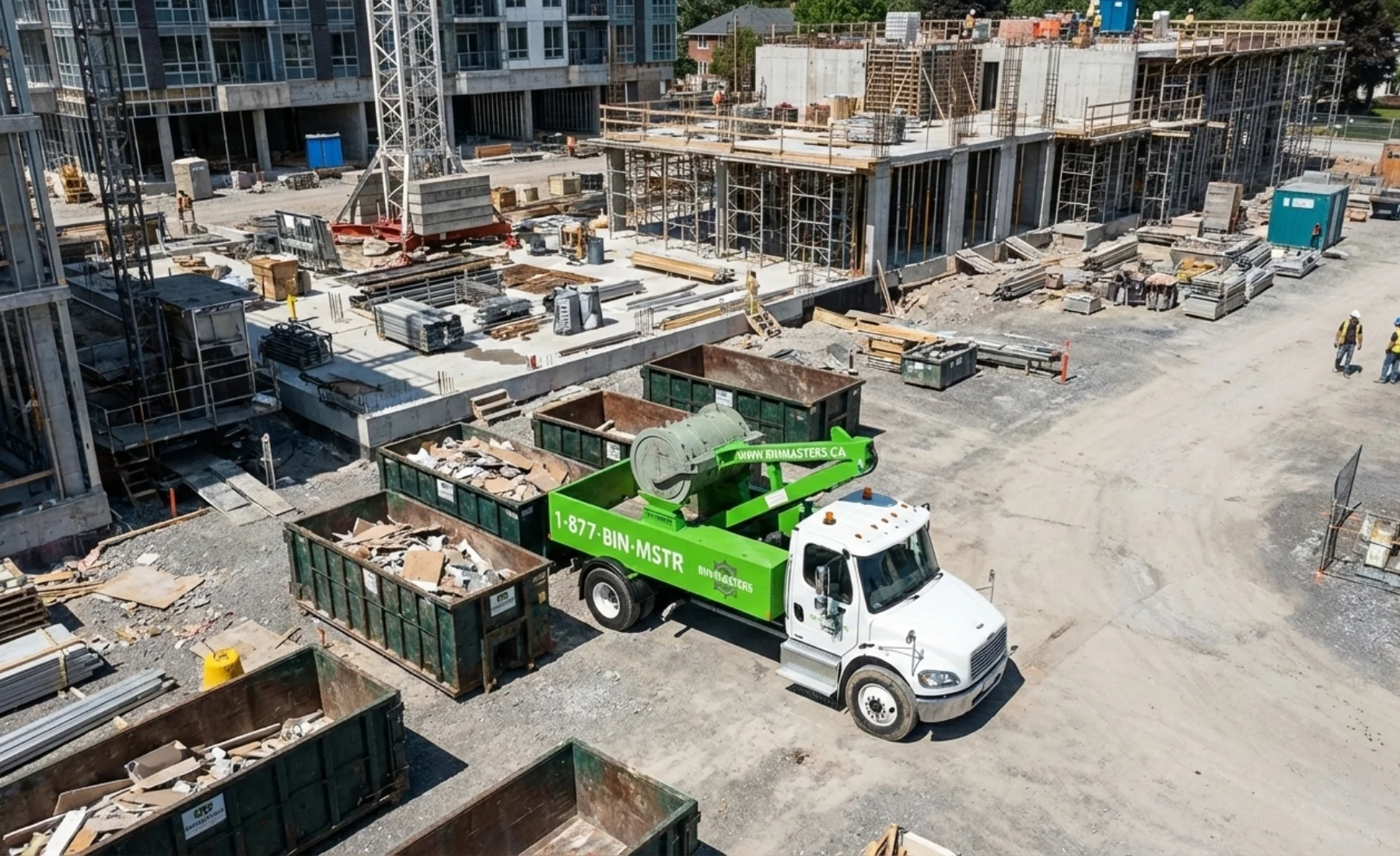
By compacting waste directly inside existing open-top containers, BinMasters increases load density by roughly 3:1, creating a cascade of financial benefits.
1. Drastic Reduction in Haul Fees
A facility generating 60 cubic yards of waste per week would typically require two 30-yard pickups. With compaction, that same waste is compressed into roughly 20 yards, reducing hauling frequency from 104 pickups per year to approximately 35, a 66% reduction in haul fees, fuel surcharges, and admin costs.
2. Elimination of Overage Charges
Overflowing bins attract penalties. By keeping waste compacted below the rim, BinMasters eliminates overage fees entirely.
3. Administrative Efficiency
Fewer hauls mean fewer invoices to process. Reducing hauling frequency by 60% also reduces administrative workload by 60%, simplifying vendor management and back-office operations.
Hypothetical Case Study: The Retail Plaza Scenario
Scenario A: Traditional Hauling
- Two 8-yard containers emptied four times per week
- ~34 monthly pickups
- $75 per haul
- Total monthly haul spend: $2,550 (plus surcharges)
Scenario B: BinMasters Mobile Compaction
- Same containers
- Bins compacted twice per week
- Hauler needed once per week
- ~4 monthly pickups
- $300 in haul fees
- $1,200 BinMasters service fee
- Total monthly spend: $1,500
Result: $1,050 saved per month, or more than $12,000 annually, before accounting for labor and safety gains.
Calculating Your True ROI
Step 1: Current Spend
(Monthly hauls × rate) + (labor hours × wage) + overage fees
Step 2: Compaction Model
(Current hauls ÷ 3 × rate) + BinMasters service fee
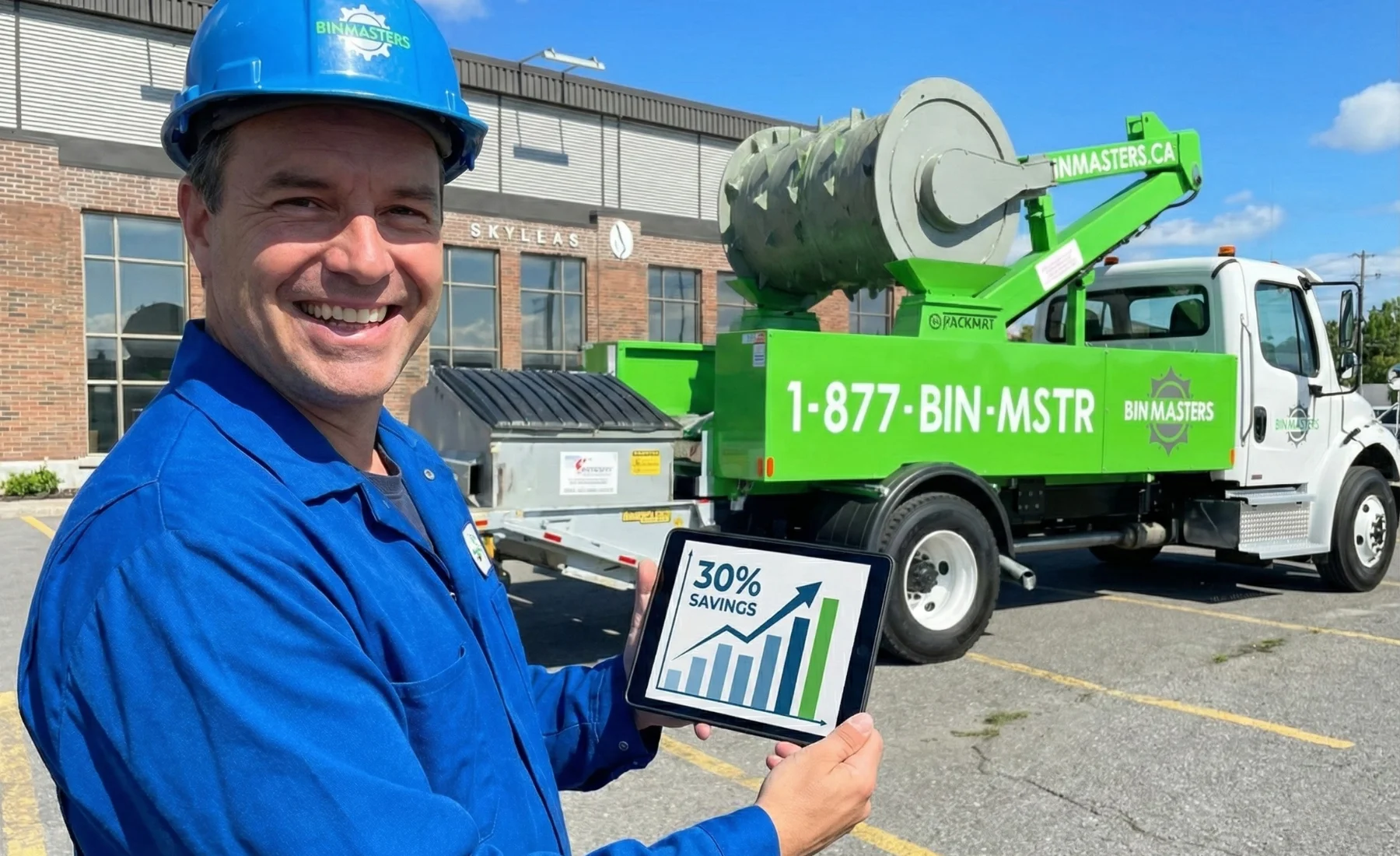
In most facilities generating more than 40 cubic yards of loose waste per week, compaction delivers immediate savings of 20–35%.
Conclusion
Efficiency is the only competitive advantage that lasts. Continuing to pay for air in your dumpsters is a relic of the past. When you analyze waste management through the lens of Total Cost of Ownership, the inefficiencies of loose-waste hauling become impossible to ignore.
BinMasters doesn’t just compact waste, it delivers a financial strategy that turns waste management into a lean, efficient operation. Don’t let your budget go to the landfill. Compact it.
Références
[1] Agence de protection de l'environnement des États-Unis (EPA). (2023). "Managing and Reducing Wastes: A Guide for Commercial Buildings."
[2] Building Owners and Managers Association (BOMA) International. (2022). "Operating Expense Benchmarks for Commercial Real Estate."
[3] Waste Business Journal. (2023). "Waste Market Overview & Outlook 2023."
[4] Occupational Safety and Health Administration (OSHA). (2022). "Estimated Costs of Occupational Injuries and Illnesses."